




Is “cavity = drill immediately” already outdated? What the latest research reveals about the current state of “non-drilling” treatments
むし歯の大きさにより、判断は変わる
Introduction: Have you ever been told “Let’s keep an eye on it” at the dentist?
- When a cavity is found during a dental checkup, you may have been advised to “monitor it for a while” instead of drilling right away—and felt uneasy. You might wonder, “Won’t it get worse if we leave it?” In fact, this reflects a major paradigm shift in global dentistry.
- Where “cavity = immediate drilling” used to be the norm, the standard is shifting—based on scientific evidence—toward “tooth-preserving care” that avoids drilling as much as possible. From the perspective of a dental health information scientist, this article explains where we stand now, drawing on the latest research data that tracked trends for over a decade (Lundbeck et al., 2026).
- Striking data: Fewer dentists are drilling occlusal caries on molars
- A recent systematic review (an update to 2016 research, published in 2026) that examined when dentists decide to drill shows a dramatic shift in how occlusal (biting) surfaces of molars are treated.
- Two data points stand out:
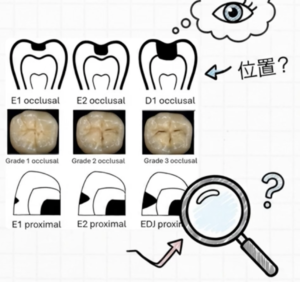
- Very early caries (E1/E2: confined within the outer enamel layer): Before 2016, 15% of dentists drilled; since 2016, that has dropped to just 5%.
- Early dentin caries (D1: reaching the entrance to dentin, the inner layer): Before 2016, 78% said they would “drill immediately”; since 2016, that has plunged to 40%. Why has “not drilling” become so prevalent on occlusal surfaces? Because they are directly observable to dentists, making it easier to accurately assess progression. As a result, an approach that maximizes the chance to avoid drilling—through fluoride-induced remineralization and sealing pits and fissures with sealants—has become established.
- Caution: Are “between-teeth” caries still treated early?
- In contrast to occlusal surfaces, a somewhat concerning trend appears for “interproximal” (between-teeth) caries. For patients who wish to preserve their natural teeth as much as possible, the numbers may be surprising: there is a stronger tendency to drill earlier than before.
- For caries confined to enamel (E1/E2), the proportion of dentists choosing to drill increased from 19% to 27%. Moreover, once the lesion reaches the enamel–dentin junction (EDJ)—the practical “decision point”—those opting to drill surged from 39% to 61%.
- Why such divergent decisions?
- “Interproximal caries are difficult to visualize directly, and diagnostic limitations plus progression risk tend to drive more invasive (drilling) choices.”
- Because interproximal areas cannot be seen directly, diagnosis relies mainly on the radiographic shadow on bitewing images. But from radiographs alone, it’s hard to be 100% certain whether drilling is truly necessary, so to avoid risk, many adopt a cautious (or proactive) stance of “drill at EDJ.”
- The concept you should know: Minimally Invasive Dentistry (MID)
- To address this and protect patients’ teeth for life, a new standard—MID (Minimally Invasive Dentistry)—has emerged. This is not merely “delaying drilling,” but a scientific strategy to actively manage lesions.
- MID consists of three steps:
- Prevent new lesions: Improve diet and use fluoride to create a low-caries environment.
- Non-surgical and micro-invasive care: Do not treat early caries as drillable; instead, promote remineralization with topical fluoride (non-invasive) and arrest progression or return an active lesion to health with sealants (micro-invasive).
- Minimal operative intervention: If drilling is truly necessary, remove only the infected tissue in a highly targeted manner. “Let’s keep an eye on it” does not mean “do nothing.” MID is proactive care using non-surgical interventions to keep your teeth in a stage where drilling can be avoided.
- Why do dentists differ on whether to drill? Treatment decisions depend not only on the lesion itself, but also on patient factors and regional context.
- Risk differences: Patients with high sugar intake or limited fluoride exposure (higher caries risk) are more likely to be drilled even for enamel lesions (29% at low risk vs. 44% at high risk).
- Regional practice culture: For enamel lesions, drilling rates are very conservative (non-drilling) in Scandinavia at just 3–9%, but reach 22% in North America. In other words, there is no single “correct” answer—your habits and your dentist’s philosophy can shape the decision.
- Conclusion: What we can do to protect our own teeth This review highlights that while “non-drilling” options for early occlusal caries are spreading worldwide, interproximal caries still tend to receive cautious or earlier intervention. Knowing these data isn’t meant to cause anxiety—it’s to help you build a better partnership with your dentist. At your next checkup, if a cavity is found, consider asking—armed with scientific insight: “Is this lesion at a stage where we can manage it non-operatively with remineralization?” That one question may become a turning point that extends the life of your teeth.
Reference
Lundbeck, H. J., Pitchika, V., Wilson, P., Raggio, D. P., Galloway, J., Al-Yaseen, W., … & Innes, N. (2026). Dental practitioners’ thresholds for restorative intervention in carious lesions: a survey-based systematic review update. Caries Research, 60(1), 65-79.
Ask question/ Send the Email to Mr. Root canal, Dr. Miyashita
Make an appointment for consultation today.
Tokyo International Dental Clinic Roppongi
- Address: 5-13-25-2nd Floor, Roppongi, Minato-ku, Tokyo
- Phone: 03-5544-8544
- Closest Stations:
- Azabu Juban (Toei Oedo Line take exit7)
- https://youtu.be/iIeG91YEJTA The way to the clinic from Ohedo Line Exit7
- Azabu Juban (Tokyo Metro Namboku Line exit 5a )
- https://youtu.be/3yniFSfucGg The way to the clinic from Namboku Line Exit 5a
- Roppongi (Hibiya Line exit 3)
We look forward to helping you achieve a healthy, beautiful smile!
Hiroshi Miyashita DDS.
Specialist in Periodontology and Endodontics
Certified by the University of Gothenberg, Sweden in 1996
医療法人社団EPSDC