




The Shocking Truth Behind “Recurrent” Root Canal Failure: Why Does a Treated Tooth Hurt Again?
1. Introduction: If you seek perfection, know what “recurrence” really is
“You underwent meticulous treatment, yet that tooth feels odd again.” “Retreatment was suggested, but why did a tooth that was ‘fixed’ go bad again?”
The more carefully you choose the best care for your health and appearance, the more unsettling this feels. Why does the wall of “recurrence” still appear despite modern dentistry?
A recent study by endodontic authority Domenico Ricucci and colleagues (Ricucci et al., 2026) brings scientific clarity. Tracking failed cases at the microscopic level, it reveals what truly happens inside recurrent teeth—and why an uncompromisingly precise approach is essential to protect the lifelong asset that is your natural tooth.
2. Takeaway 1: In 94% of failures, “survivor” bacteria inside the tooth are the cause
Histopathologic analyses of failed, recurrent cases show that in fully 94% of teeth, bacteria persist at the root apex.
These are not free‑floating microbes. In most cases (79%), they are bound together in a polysaccharide stronghold—biofilm—that resists medicaments and immune attack.
“Intraradicular infection was the principal factor associated with post‑treatment apical periodontitis.” (Ricucci et al., 2026)
Specialist insight: Nearly all recurrences stem from “left‑behind bacteria.” Simply replacing old filling material is close to meaningless. The only way to break the chain is an advanced disinfection protocol that drives the microbial load toward “near‑zero.”
3. Takeaway 2: The biofilm “fortress” hides in a labyrinth of ultra‑fine spaces
Why is eradication so hard in one treatment? Because the inner tooth is astonishingly complex.
In up to 65% of cases, biofilm penetrates not only the main canal but also very fine lateral canals. Clinical microscopy (e.g., MB2) often shows, even after treatment, a maze packed with necrotic debris and bacteria.
Specialist insight: Naked‑eye treatment cannot conquer this “micro‑labyrinth.” Endodontic microscopy to visualize branches, combined with ultrasonic activation and chemical irrigation to reach every recess, defines the line between extraction and tooth preservation.
4. Takeaway 3: Bacteria “escape” outside the root and survive by calcifying
Strikingly, bacteria sometimes break out from inside the tooth and colonize the root surface—extra‑radicular infection was found in ~37% of failures. They form biofilm on the root, at times calcifying like calculus. Once established, no amount of irrigant from inside can destroy this base.
Specialist insight: When the fortress extends extra‑radicularly, conventional (intraradicular) retreatment has limits. Surgical endodontics (apical microsurgery) must be considered. Sound diagnosis to identify this “threshold” is critical.
5. Takeaway 4: “Imperfect fillings” are prime real estate for bacteria
Failure correlates with prior treatment quality. Underfills or low‑quality obturations are associated with significantly higher biofilm prevalence (P < .05). Any tiny void (dead space) is a “safe house” for explosive bacterial growth.
Specialist insight: Use top‑tier bioceramic sealers and warm vertical compaction to hermetically seal canals with micron‑level precision. This isn’t mere neatness—it’s the surest investment in your time and health, and the strongest insurance against reinfection.
6. Takeaway 5: A large “lesion” does not automatically mean extraction
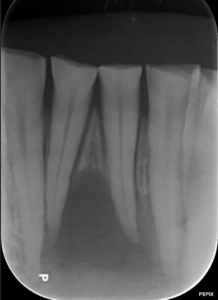
Even if a large radiolucency (“black shadow”) appears and you’re told the tooth is hopeless, don’t give up. Ricucci’s pathology shows the shadow is not always dire.
The most common diagnosis in recurrent cases was non‑epithelialized granuloma (42%)—a vascular, highly healing‑capable immune response. Precisely removing the source of infection often allows the lesion to resolve and healthy tissue to return.
Notably, true cysts—often deemed hard to heal—accounted for only ~1%.
Specialist insight: “Shadow = extract” is far too simplistic. With evidence‑based specialist care, many teeth are salvageable. Before you choose an irreversible extraction, trust the tissue’s capacity to heal—and seek a precise diagnosis.
7. Conclusion: A forward‑looking summary and a question
Root canal outcomes are not decided by surface symptoms or a single X‑ray shadow, but by an elite intellectual and technical battle against “micro‑bacteria” hidden in a deep anatomic labyrinth.
To turn a failure into success, scientifically identify the original cause, dismantle the biofilm fortress completely, and seal the system so tightly that re‑entry is impossible.
One last question:
“What level of treatment precision will you choose today to keep your important tooth 10–20 years from now?”
Reference
Mosquera‐Barreiro, C., Ruíz‐Piñón, M., Sans, F. A., Nagendrababu, V., Vinothkumar, T. S., Martín‐González, J., … & Castelo‐Baz, P. (2024). Predictors of periapical bone healing associated with teeth having large periapical lesions following nonsurgical root canal treatment or retreatment: A cone beam computed tomography‐based retrospective study. International endodontic journal, 57(1), 23-36.
Ask question/ Send the Email to Mr. Root canal, Dr. Miyashita
Make an appointment for consultation today.
Tokyo International Dental Clinic Roppongi
- Address: 5-13-25-2nd Floor, Roppongi, Minato-ku, Tokyo
- Phone: 03-5544-8544
- Closest Stations:
- Azabu Juban (Toei Oedo Line take exit7)
- https://youtu.be/iIeG91YEJTA The way to the clinic from Ohedo Line Exit7
- Azabu Juban (Tokyo Metro Namboku Line exit 5a )
- https://youtu.be/3yniFSfucGg The way to the clinic from Namboku Line Exit 5a
- Roppongi (Hibiya Line exit 3)
We look forward to helping you achieve a healthy, beautiful smile!