



Why Treating Baby Teeth Can Help Protect Permanent Teeth
Protect adult teeth by treating milk teeth
Here’s a surprising story about dental care: How can treating baby teeth help protect the permanent teeth that grow in later?
The answer may involve something called the “zombie effect.”
1. The Mouth Is One Big Community
The teeth in your mouth don’t live separately from one another. Your mouth is more like one big community where teeth share saliva and bacteria.
When a baby tooth has a cavity, many cavity-causing bacteria can live in it and spread through the mouth in saliva. This means that if a child has many cavities in their baby teeth, newly emerging permanent teeth may enter an environment where cavity-causing bacteria are already common.
2. What Is the “Zombie Effect”?
In one study, researchers applied a special gel containing silver ions to cavities in baby teeth. Something surprising happened: the permanent teeth were less likely to develop cavities—even though the gel had not been applied directly to them.
How could that happen? One possible explanation is the “zombie effect”:
- Killing bacteria: Silver ions help kill cavity-causing bacteria.
- Silver remains in the dead bacteria: Some of the silver ions stay attached to parts of the bacteria.
- The silver is released over time: As dead bacteria break down, they may release some of the silver ions back into the mouth.
- More bacteria are affected: The released silver ions may then help kill other bacteria nearby.
In this way, treated baby teeth may act like a “silver reservoir,” helping reduce bacteria in the mouth. The “zombie effect” is a proposed explanation for how silver ions might continue to act after the bacteria are killed.
3. Does It Really Work?
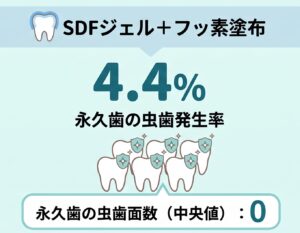
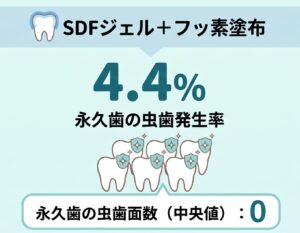
A study in Peru followed children who had severe cavities in their baby teeth. When the children were 3–4 years old, some received a treatment using a special gel. About a year and a half later, researchers checked their newly erupted first permanent molars, often called “six-year molars.”
- Children who received the treatment: About 4% had cavities in these permanent molars.
- Children who did not receive the treatment: About 67% had cavities—roughly two out of every three children.
These findings suggest that treating cavities in baby teeth may be linked to fewer cavities in permanent teeth that come in later. However, because this was an observational study—not a randomized experiment—the results do not prove that the treatment alone caused the difference.
4. Why Is This Important?
One benefit of this treatment is that it may help stop cavities from getting worse without drilling. It may also be easier for some young children to receive than traditional treatment.
- Treated baby teeth may act as a “silver reservoir”: Silver ions may continue to affect bacteria in the mouth.
- The treatment can be less invasive: It may be an option for some children who find dental procedures difficult.
- Caring for baby teeth matters: Healthy habits and early treatment can help protect the teeth that come in later.
It’s not a good idea to leave a cavity untreated just because a baby tooth will eventually fall out. Taking care of baby teeth is an important step toward protecting permanent teeth. Regular dental checkups, brushing with fluoride toothpaste, healthy eating habits, and preventive treatments recommended by a dentist all play a role.
Reference
Cáceres+2026 Dental Caries in Permanent Molars of Children Previously Treated With Silver Fluoride Gel/Sodium Fluoride Varnish in Their Primary Dentition: A Retrospective Cohort Study. International Journal of Paediatric Dentistry, 2026; 0:1–6
Ask question/ Send the Email to Mr. Root canal, Dr. Miyashita
Make an appointment for consultation today.
Tokyo International Dental Clinic Roppongi
- Address: 5-13-25-2nd Floobonyuur, Roppongi, Minato-ku, Tokyo
- Phone: 03-5544-8544
- Closest Stations:
- Azabu Juban (Toei Oedo Line take exit7)
- https://youtu.be/iIeG91YEJTA The way to the clinic from Ohedo Line Exit7
- Azabu Juban (Tokyo Metro Namboku Line exit 5a )
- https://youtu.be/3yniFSfucGg The way to the clinic from Namboku Line Exit 5a
- Roppongi (Hibiya Line exit 3)
We look forward to helping you achieve a healthy, beautiful smile!
Hiroshi Miyashita DDS.
Specialist in Periodontology and Endodontics
Certified by the University of Gothenberg, Sweden in 1996