



Why are root caries increasing in an era when we can keep our teeth longer?
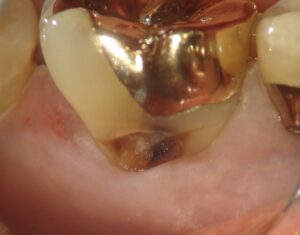
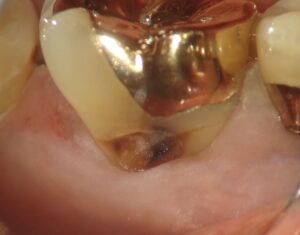
Root caries was developed at the lingual side of the lower jaw in 50yo lady.
First, the takeaway
- As more people keep their teeth longer, “root caries” on exposed root surfaces (dentin) are increasing worldwide.
- Root surfaces are softer than enamel and decay progresses faster. Early care and prevention are essential.
What are root caries?
- When we’re younger, cavities tend to occur on the tooth crown (enamel).
- With age or periodontal disease, the gums recede and the root surface (dentin) becomes exposed. Decay that develops there is called “root caries.”
- Dentin is softer and more acid-sensitive than enamel, so decay can advance quickly and may be extensive before you notice it.
Five surprising facts from recent global data
- The “paradox” of richer countries having more root caries
- In wealthier countries with good healthcare access, people keep more of their natural teeth, leading to more exposed root surfaces.
- As a result, the “opportunity” for root caries increases—a seeming paradox.
- Key point: Keeping teeth is good, but we must strengthen “root care” at the same time.
- Why the numbers may look lower in people in their 80s (a numbers illusion)
- Data often show root caries counts rising into the late 70s, then decreasing in the 80s.
- The reason isn’t “teeth getting stronger,” but that more people lose teeth as disease progresses.
- Key point: Fewer lesions on paper doesn’t equal safety. Early, proactive care matters.
- Big differences between countries mean prevention works
- Some countries report about 4% of people with root caries (e.g., Denmark), while others report around 97% (e.g., Mexico).
- Prevention programs, fluoride use, lifestyle, and regular maintenance make a major difference.
- Key point: With the right measures at a community level, root caries can be significantly reduced.
- About 41% of the world is affected—quality of life (QOL) is at stake
- Estimates suggest older adults may have 2–3 root caries on average. Left untreated, these can cause pain, fractures, and tooth loss.
- Difficulty chewing can lead to poor nutrition, reduced strength, and a drop in quality of life.
- Key point: This is not just an oral issue—it affects overall health and diet.
- Data gaps remain—and caregivers are the next key players
- We still lack high-quality data in some regions (e.g., parts of Africa).
- Going forward, educating caregivers/family and building local prevention systems will be crucial.
- Key point: In later life, shift from “self-reliant care” to “care supported by those around you.”
Practical prevention you can start today
- Daily plaque removal
- Use a soft toothbrush with gentle pressure—don’t scrub hard.
- Clean the “root–gum boundary” with interdental brushes and floss.
- Make fluoride your ally
- Use a high-fluoride toothpaste (e.g., 1450 ppm).
- Apply before bed and rinse minimally to leave fluoride on the teeth.
- Address dry mouth and diet
- Avoid frequent snacking, high-sugar snacks, and frequent acidic drinks.
- If you have dry mouth, sip water often, consider moisturizing gels, and review medication side effects.
- Regular maintenance and early detection
- Because root caries progress quickly on exposed dentin, schedule regular checkups and cleanings for proactive care.
- Consider professional fluoride applications, sealant-like coatings, and treatments for sensitivity as needed.
Signs you should see a dentist
- Sensitivity to cold or sweets, visible gum recession with exposed roots, dark or rough spots at the root, pain when a denture or brush touches the area, or sharp pain when biting.
Summary
- Precisely because we can keep teeth longer, “root care” is the new normal.
Sustainable prevention = the right tools × gentle brushing × fluoride × regular checkups × support from family/caregivers.
Reference
Maklennan, A., Borg-Bartolo, R., Roccuzzo, A., Salerno, C., Raabe, M. K., Monterubbianesi, R., … & Campus, G. (2025). Meta-analysis of global distribution of root-caries prevalence in middle-aged and elderly. Caries Research, 59(4), 298-314.
Ask question/ Send the Email to Mr. Root canal, Dr. Miyashita
Make an appointment for consultation today.
Tokyo International Dental Clinic Roppongi
- Address: 5-13-25-2nd Floobonyuur, Roppongi, Minato-ku, Tokyo
- Phone: 03-5544-8544
- Closest Stations:
- Azabu Juban (Toei Oedo Line take exit7)
- The way to the clinic from Ohedo Line Exit7
- Azabu Juban (Tokyo Metro Namboku Line exit 5a )
- The way to the clinic from Namboku Line Exit 5a
- Roppongi (Hibiya Line exit 3)
We look forward to helping you achieve a healthy, beautiful smile!
Hiroshi Miyashita DDS.
Specialist in Periodontology and Endodontics
Certified by the University of Gothenburg, Sweden in 1996